
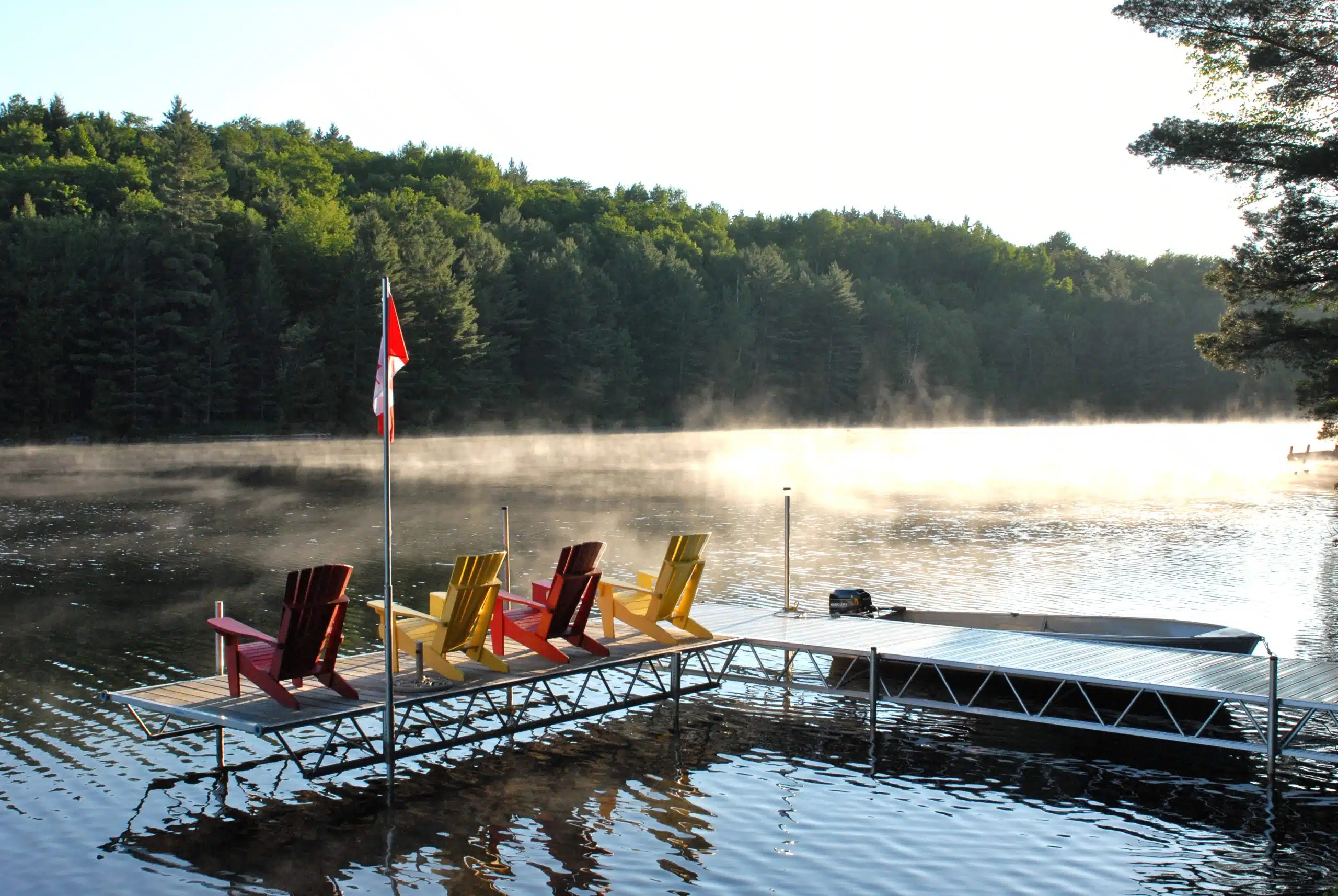
Life is busy, and cottage owners increasingly want to enjoy their waterfronts rather than work on them. With an aging demographic and more families sharing cottages across generations, expectations have shifted toward turnkey, low maintenance solutions, that turn a weekend at the lake into moments of joy instead of hours of upkeep.
Cottage time should feel like a break, not another project, and nowhere is that truer than at the shoreline.
“People want to enjoy their waterfront, not spend every weekend maintaining it. They want solutions that go in quickly and don’t require annual upkeep,” says Mélanie Schwery, Sales Director at Multinautic, which manufactures innovative, modular dock kits and hardware.
Roger Gainer, president of Docks & Decks Unlimited in Greater Sudbury, sees the same shift. The Castle Building Centres dealer, who has been building docks for nearly 40 years, says cottage owners are increasingly looking for professionally installed, turnkey systems that minimize effort. “People want turnkey service. They’d rather have us come in, build it, and tell them the final price than install it themselves. There isn’t much of the do it yourself approach anymore.”

Photo courtesy of MULTINAUTIC
Many are also willing to invest in higher end, low maintenance materials to maximize their leisure time by the water. “They’re looking for maintenance free products. Some shy away from the price at first, but most are prepared to upgrade to higher end decking. Cedar has fallen off up here (in Northern Ontario). It just doesn’t last the way it used to,” he adds.
Clive Savin, sales manager at BRT Distributing, an Ontario based supplier of Interco docks and accessories, notes that convenience now drives most purchasing decisions. “People want a convenient dock. Something that’s simple to work with; a turnkey experience. They want something where you do everything for them and, when you leave, it’s done and it’s simple for them to put away for the winter time.”
For many cottage owners, that means relying on dealers and vendors who can build, install, and configure the entire system , a one stop shop that delivers a ready to enjoy dock and eliminates the seasonal headaches that once defined waterfront ownership.
“A lot of people are being more mindful of their time at the cottage and looking for solutions to reduce workload and increase enjoyment,” says Kurt Westwell, Senior Vice President at Fendock, the dock manufacturing division of Fendor Glass & Aluminum.

Photo courtesy of DOCKS & DECK UNLIMITED

Photo courtesy of BRT DISTRIBUTING
A Shoreside Living Room
Even as cottagers seek simplicity in dock ownership, their expectations of the dock itself have expanded. For many, gone are the days of a small boat mooring point.
They’re taking funds that might have gone toward out of country vacations and investing them in turning their cottage dock into a more usable space for seating, gathering, and entertaining while enjoying the view.
“We’re seeing much larger on the water seating areas this year. Not just an eight foot platform; people are asking for 16×16, 20×20, even 24×24 one piece decks,” Gainer says. “They want places to sit, gather, and enjoy the lake. Instead of a small spot to tie up a boat, they’re effectively putting the deck on the water because the terrain around the cottage isn’t always ideal for a big seating area.”
To that end, today’s docks demand space: enough room for oversized Adirondack chairs, loungers, coolers, and friends pulling up by boat. It’s no longer about size for its own sake but about creating a space that fits the way people actually use the lake.
Jason Pulchinski, President of ATL (At the Lake) Distributing, who supplies dock systems and cottage recreational products to dealers across cottage country, sees docks evolving into full social spaces.
“The dock space is becoming like a second living room. Back in the day, a dock was just some old wooden thing; a couple of logs, some floats, tie your boat up and that was it,” he says. “But nowadays we’re seeing the trend toward bigger, more elaborate docks with accessories, seating spaces, and social areas. On a lake, you typically have people visiting by boat, and it’s become a big gathering place.”

Photo courtesy of ATL Distributing

Photo courtesy of DOCKS & DECK UNLIMITED
Materials that Reduce the Work
Cedar, a traditional choice for dock material due to its natural resistance to water and mold, is giving way to products that reduce maintenance. Composite, aluminum, and PVC are getting their day in the lakefront sun, extending the life of a cottage owner’s investment while reducing upkeep.
“Composite has been growing for a few years now. People want the nicest dock they can get, and they want to use it, not spend the early summer sanding and staining,” Schwery says. “Cedar still has a beautiful and classic look, but composite lasts longer and requires almost no work.”
The shift to low-maintenance dock materials and growing demand for turnkey services are creating opportunities for contractors who specialize in marine work, as well as those looking to add it to their portfolios.
“We almost find that this time of year it’s a challenge to keep up with orders because a lot of people are switching out older systems,” Westwell says. “When it comes time to renew the dock, even a lot of older customers are just switching over to aluminum system.”
Material choice and dock style depend on shoreline conditions and, of course, budget, Savin notes. High fluctuations in water levels lead to floating docks, including those built with his company’s Shared Sunset aluminum frame, finished with either pressure treated wood or PVC materials.
“Most people will now take the budget and go with PVC because it’s a dock for life,” he explains.

Photo courtesy of Multinautic
Hardware and Construction: Get it Right the First Time
When it comes to building a dock that weathers the seasons, Gainer says it’s crucial not to cut corners on hardware. The most common mistake he sees is cottage owners using undersized or bargain components on floating docks. They may hold for a few seasons, but when they fail, often when no one is at the cottage, docks can break loose and boats can end up banging against the shore.
“You’re out there in the middle of the night trying to secure it, and it’s not fun,” he says. The problem, he adds, usually comes down to lack of preparation and “putting money in the wrong spot.” Most people eventually return to buy the proper hardware they should have used from the start.
Choosing the Right Dock: Practical Tips
Just as they do around materials, shoreline realities inform contractors and do‑it‑yourself weekend warriors on dock choices, with wind strength, water depth, ice movement, and sun exposure looming large in decisions.
In exposed locations, floating docks can become unstable or drift, and in shallow water they may not sit properly at all. “Some places are way too windy to have a floating dock,” Gainer says, noting that wave action and prevailing winds dictate whether a dock should float or stand on posts.
Depth is another deciding factor. “If the water is under about four feet, you’re usually better off with posts,” Schwery suggests. Fixed systems offer more stability in shallower bays, while floating docks support deeper water and areas with significant water level changes.
Seasonal forces add their own complications. Even the strongest frames aren’t immune to winter pressure, ice and shifting loads. “They can bend steel, so there are no guarantees,” Westwell says. That’s why many cottage owners lean toward modular systems, wheel kits, and ramps that make seasonal removal easier and reduce the risk of damage.
Savin adds that, “Every shoreline is different, every cottage is different, everybody’s needs are different.” That’s why his company custom builds to customer specifics, sizes and needs, and engages in site visits.
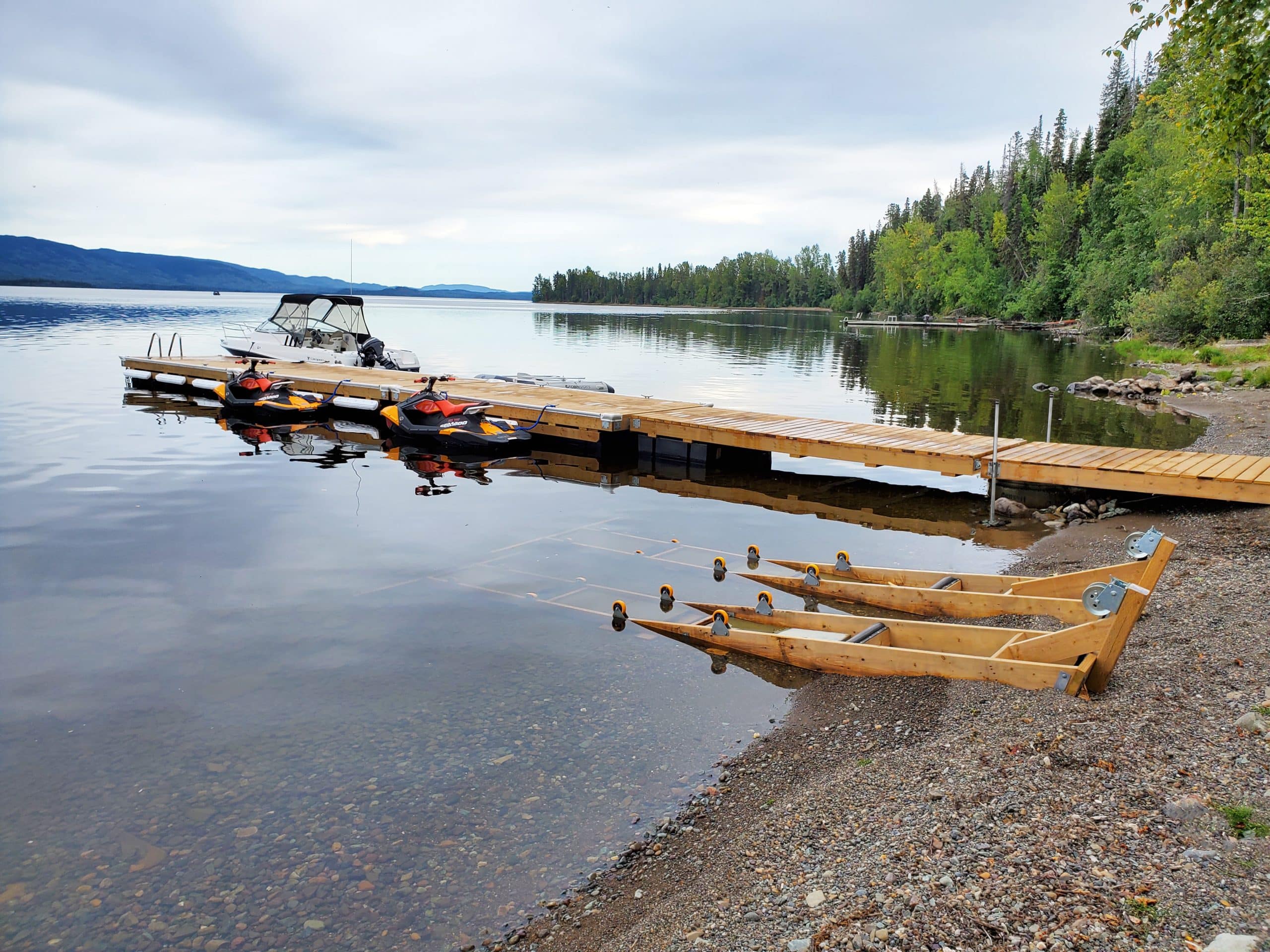
Photo courtesy of Multinautic
Accessories that Matter
As owners seek docks that enhance their cottage lifestyle, rather than simply provide a place to moor, accessories are becoming more and more essential.
Gainer points to the increased popularity of lights, racks and storage, as well as bumpers, cleats and lifts that extend the dock’s functionality. “People are installing solar powered lights. We’re getting asked a lot about kayak racks, so you don’t have to haul the kayak back up to the head.”
With that in mind, quality is uncompromising. “People want to accessorize their docks with kayak racks, paddleboard racks and storage options. With the amount of money people spend on their docks and accessories, they want to keep everything looking good for a long time.”
Fun on the Water
With multigenerational visits to the cottage, while connecting with nature might be top of mind, a few marine additions are adding some much-needed excitement, especially for, but by no means exclusively for, younger cottagers.
Kayaking and lounging in an Adirondack is great, but Pulchinski points to the popularity of the inflatable play structures his company carries. “These are super high-end, made for camps and resorts but work equally well at a private cottage,” he says. “And the nice thing is they provide hours of fun for all ages, and you don’t have to put any gas money into them.”
Whether it’s a water trampoline, catapult swing, climbing wall or freefall slide, inflatables help with the hard job of occupying today’s screen-obsessed generation, and keep them wanting to come back. “You know, as we get older, and the kids or the grandkids to come up and enjoy the cottage, you don’t want to be bored and… when it’s 30°C and a beautiful sunny day, you want to encourage the family to get outside together.”

The Value of Experience
With so many considerations involved in waterfront cottage projects, expertise matters. Working with the right dealer, distributor, or vendor who has shoreline knowledge, understands buoyancy and climate considerations, provides technical support, and knows the site can make or break a dock or accessory installation.
Sometimes, the best guidance for a lakeside property is closer than you think; just ask the neighbours. Schwery advises: “People often say, ‘I don’t know how deep the water is.’ The easiest thing is to look at what your neighbours are using or simply ask them. Shorelines tend to behave the same way within a bay.”
She reminds cottage owners and contractors alike that a dock is a significant investment, one where the right expertise can make all the difference.
“It’s not a small investment,” she says. “The best way to know if your dealer is solid is to see if they have someone in the store who really knows docks. Dealers who work with us usually have one champion, that one person who knows everything.”
Because building the right dock is about more than choosing the right materials; it’s about partnering with people who understand the shoreline, the environment, and the lifestyle it supports. After all, a dock is more than a structure, it’s where memories are made, seasons are enjoyed, and cottage life truly begins at the water’s edge.

Photo courtesy of Multinautic